Luxor
Luxor
The short version
- A standard ticket covers three tombs from the open rotation — Tutankhamun, Seti I and Nefertari all cost extra, separately.
- The three most people default to are Ramesses IX, Ramesses IV and Tutankhamun. Only one of those earns its place.
- Our usual three: KV11 (Ramesses III), KV2 (Ramesses IV) and KV14 (Tausert/Setnakht)— subject to what's open that week.
- Seti I (KV17) costs around €50 extra and is the single best thing in the Valley. If you only splurge once, splurge here — not on Tutankhamun.
- The rotation changes constantly. The right answer this month is not the right answer next month — which is the entire argument for having someone local check before you go.
Here is the thing nobody explains at the ticket booth: the Valley of the Kings is not one attraction. It is sixty-odd tombs, of which roughly eight are open on any given day, on a rotation that changes for conservation reasons without much announcement. Your standard ticket admits you to three of them. Which three is entirely your choice — and almost everybody chooses badly, because they choose at the gate, in the heat, with no information.
Ahmed grew up twenty minutes from that gate, and has been inside all of them. So let this save you the mistake people make every morning.
The mistake almost everyone makes
Most visitors arrive between 9 and 11am, having taken a coach from Hurghada that left at three in the morning. They are tired. It is thirty-eight degrees in the ravine. Someone points at the two tombs nearest the entrance — usually Ramesses IX (KV6) and Ramesses IV (KV2), because they are the closest and the queues move — and that is two of your three gone, chosen by proximity rather than merit.
Then they pay extra for Tutankhamun (KV62), because it is the name they know.
And this is the honest part that costs us money to say: Tutankhamun's tomb is, architecturally, one of the least impressive in the Valley. It is small. It was not built for him — he died young and they buried him in a hurry, in what was probably meant to be a courtier's tomb. The treasure that made it famous is not in it — it moved to the Grand Egyptian Museum by the pyramids at Giza, where the full five-thousand-piece collection is now shown together for the first time. What remains in the tomb is the mummy in a climate-controlled case, one decorated chamber, and a lot of people shuffling in a small space.
People come out of Tutankhamun's tomb slightly embarrassed, as though they were supposed to feel something and did not.
— Ahmed, on the west bank
It is not that you shouldn't go. If standing two metres from the boy king matters to you — and for many people it genuinely does, and that is a perfectly good reason — go. Just go knowing what it is, and do not let it be the thing you spent your money and your energy on.
The tombs actually worth your three
These are the ones we take guests into, when they are open. The Valley rotates, so treat this as a ranking rather than a fixed list.
The one we'd actually pay extra for
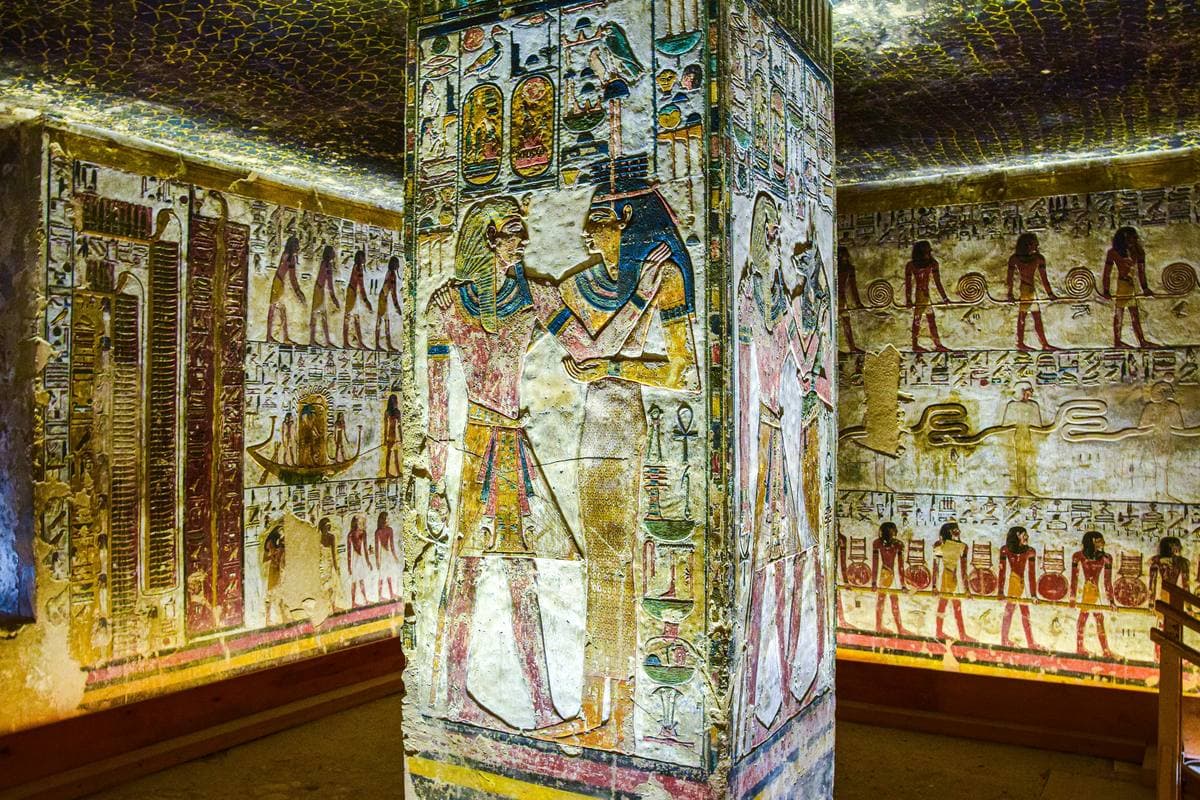
Seti I is not a tomb. It is a cathedral cut downwards into rock, over a hundred metres of it, every surface carved and painted, the astronomical ceiling still holding its blue. It was closed for decades and reopened with a separate, expensive ticket precisely because they want to limit how many bodies breathe in it.
If you are choosing between the extra ticket for Tutankhamun and the extra ticket for Seti I, and you can only justify one: it is Seti I, and it is not close.
When you go matters more than which you pick
You can choose the three best tombs in the Valley and still have a mediocre morning, because you arrived at ten with four coaches. The tombs are narrow. Forty people in a corridor built for a burial procession is not an experience, it is a queue with paintings.
The Valley opens at six. Between six and half past seven, you can stand alone in KV11. By nine, you cannot. That gap — an hour and a half — is worth more than any ticket upgrade you can buy.
- Arrive at opening. Not "early." At opening. The difference between 6:00 and 7:30 is the difference between solitude and shuffling.
- Do the deepest tomb first, while it is still cool and your legs are fresh. The descents are steeper than people expect.
- Skip the middle of the day entirely. Between eleven and three the ravine holds heat like an oven, and the light for photographs is flat and cruel.
- Come back in the late afternoon for the west bank temples, when the stone goes orange.
This is the single reason we build days the way we do. It is not that our guests get better tombs — anyone can buy the same ticket. It is that they get them empty.
What most people miss entirely
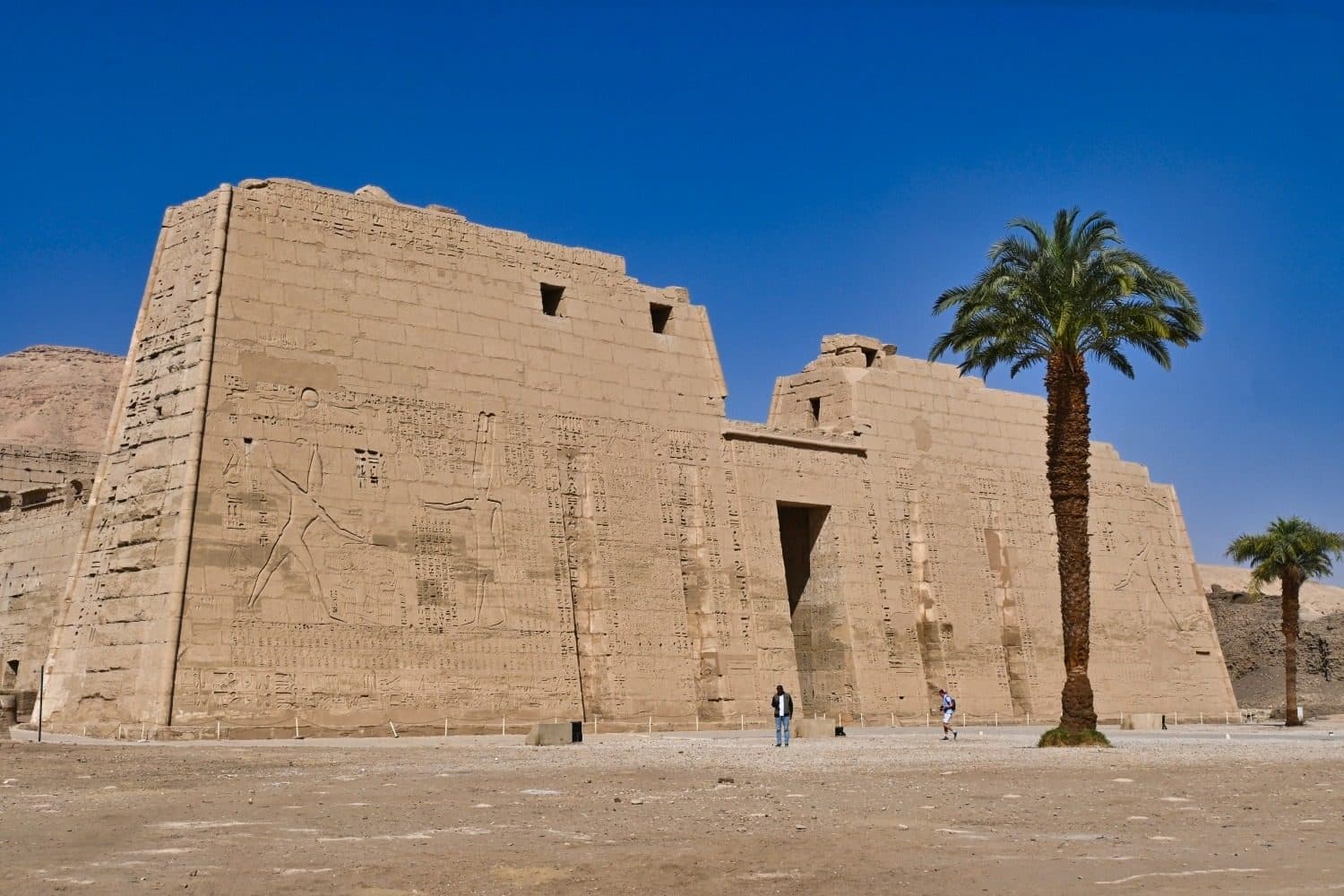
Fifteen minutes from the Valley gate is Medinet Habu — the mortuary temple of Ramesses III, still holding its original paint, and on most mornings almost deserted. It is, to our mind, the most beautiful thing on the west bank, and the majority of visitors never see it, because it is not on the coach itinerary.
Ten minutes the other way is the tomb of Nefertari, which is not in the Valley of the Kings at all but the Valley of the Queens, and which is the most beautiful painted surface most guests have ever stood in front of. Entry is capped and expensive. People come out silent. It is one of the only times we've seen tourists cry.
If you have a day here — a real day, not a stop on a bus route — you can do the Valley properly at dawn, Medinet Habu at nine while it is still cool, and be drinking tea somewhere shaded before the heat arrives. That is not a luxury itinerary. It is just the correct order, which nobody tells you.