Colossi of Memnon · Luxor West Bank · A single experience

The two giants that once sang at dawn.

Two seated giants, eighteen metres of weathered stone, standing guard on the road to the West Bank for three and a half thousand years — and one of which, for centuries, was said to sing at sunrise. A short, private, certified-guided stop at the gateway statues most people only ever glimpse from a coach window.
From115private & certified-guided
★ ★ ★ ★ ★ 5.0 · 3 guest reviews

A private, certified-guided visit to the Colossi of Memnon — the two vast guardian statues of Amenhotep III on Luxor's West Bank — with the story of the "singing" giant, timed and arranged for you.

Duration~30–45 min, private (combinable)
Best timeEarly morning or golden hour
From115
CancellationFree, up to 7 days

Instead of a two-minute roadside stop, you have the light and the time to stand with the two giants that once sang at dawn. Your Egyptologist tells you why they matter, and the moment is folded gently into your morning — with coffee at a spot only a local would know.

The last guardians of a vanished giant.

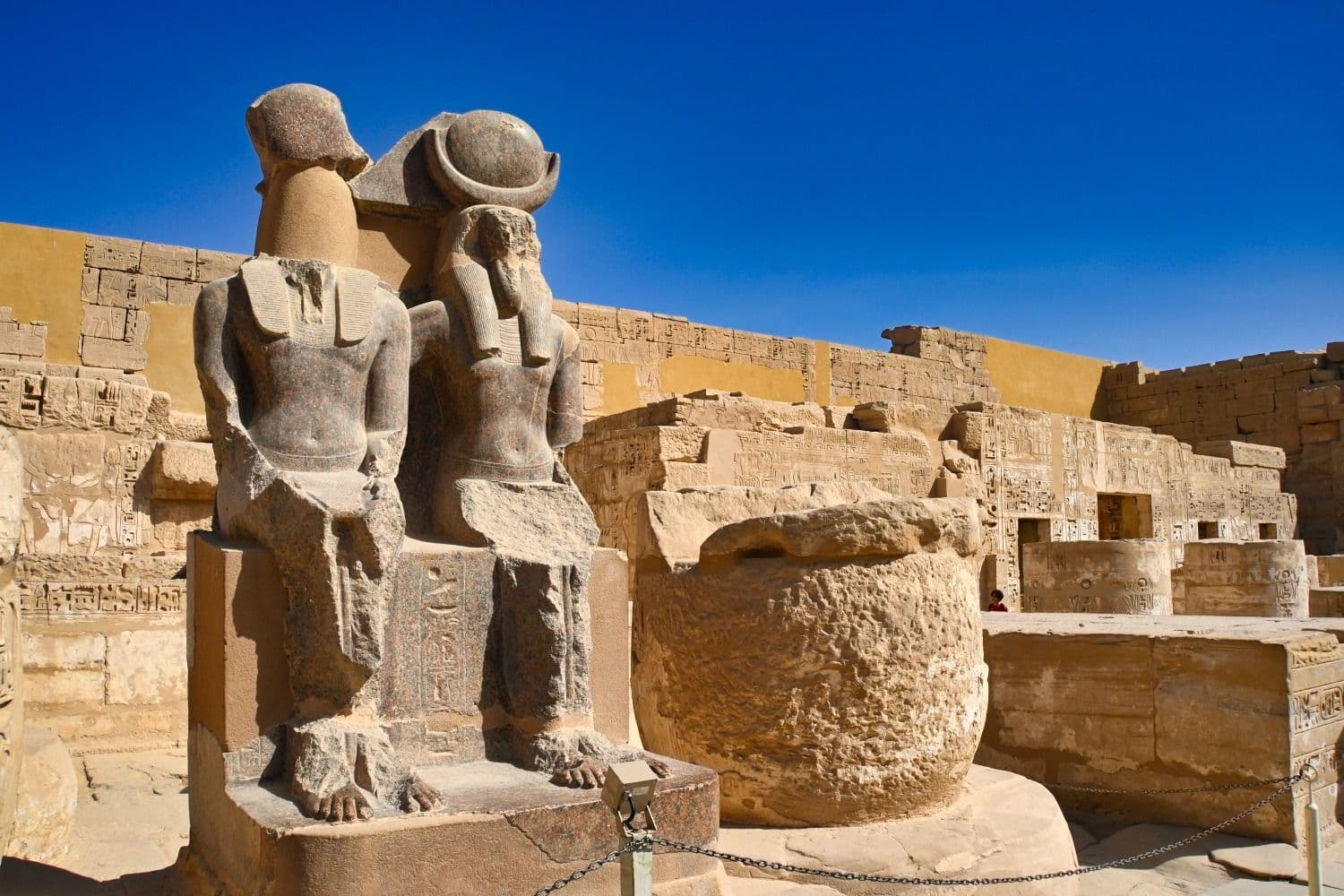
Almost everyone who visits the West Bank drives straight past them on the way to the Valley of the Kings — two colossal figures sitting alone in a field, weathered nearly featureless by three and a half thousand years of sun, flood and time. Most people photograph them from the coach and move on. Slow down, stand at their feet with someone who can tell you what they are, and the Colossi of Memnon turn out to be one of the more haunting things in all of Thebes.

They are the pharaoh Amenhotep III, twice, seated and staring east across the Nile — and they are the only survivors of what was once the largest and grandest memorial temple in the whole of Egypt.

The temple that isn't there

This is the part that reframes everything. Behind these two giants once stretched a temple bigger than Karnak — acres of courts, halls and statues, built to be Amenhotep's monument for eternity. The Nile's annual floods and later builders quarrying the stone took almost all of it. What's left are the two colossi that flanked its gate, still keeping watch over an empty plain. Your Egyptologist rebuilds it for you, so you grasp the scale of what has simply gone.

The giants that sang

Then there's the legend that made them famous across the ancient world. After an earthquake around 27 BC cracked the northern statue, it began to emit a strange musical note at dawn — the stone, most likely, warming and expanding in the first sun. Word spread, and Greek and Roman tourists, even emperors, travelled here specifically to hear the "singing" colossus of Memnon, scratching their names and poems into its base. Those inscriptions are still there. A Roman repair, meant to honour the statue, silenced it forever.

They were built to guard a temple that no longer exists, and became famous for a song they can no longer sing. Few ruins say more about time than these two.

A short stop that rewards slowing down

The Colossi are a brief visit by nature — half an hour or so — which is exactly why they work best as the atmospheric opening to a West Bank morning, before the Valley of the Kings or Hatshepsut. Come with someone who can hand you the story, at the right light, and two statues you'd otherwise have driven past become a moment you remember. Tell us your day and we'll place them perfectly within it.


Roman emperors travelled the length of the known world to hear these stones sing at dawn. They're still standing exactly where they heard them.

On the day

What you'll experience

Two giants, eighteen metres tall

A pair of colossal seated statues of the pharaoh Amenhotep III, each cut from a single block and standing since around 1350 BC — the last guardians of a memorial temple that has otherwise vanished entirely.

The statue that sang

After an earthquake cracked one colossus, it began to "sing" at dawn — a note heard by Greek and Roman tourists who came from across the empire to hear it, and who carved their names at its feet.

The temple that disappeared

Behind the giants once stood the largest memorial temple in all of Egypt — bigger than Karnak — now almost completely gone. Your Egyptologist shows you what was here and why it vanished.

The perfect West Bank opener

They stand right on the road into the West Bank, so they make an ideal first stop before the Valley of the Kings or Hatshepsut — a short, atmospheric prelude to the day.

The person at the heart of it

What is a Luxor Rising concierge?

Not a guide with a flag and a script. A concierge is one trusted person who understands where you are in your own journey, shares the road with you, and quietly arranges every last detail — the car, the tickets, the right hour, the doors — so all you have to do is be present. You manage nothing. You just flow.

A guide who understands your journey

Someone who listens first — who grasps what this trip really means to you — and then reads three thousand years in a way that speaks to it. Never a memorised tour repeated to everyone.

A companion who shares the road

A real person who knows your name, is on WhatsApp before you arrive and beside you through every day. Someone — never a call centre or a voucher.

Everything arranged, so you just flow

Cars, tickets, timing, translation, the quiet hour ahead of the crowds, and the doors that never open for a coach — all handled invisibly. You never touch a single logistic.

Meet your concierge →
Reserve your visit

Pick your date. We'll time the giants to the best light.

A short private stop at the Colossi of Memnon — your group, your Egyptologist, and the story of the singing giant.

Best paired with a West Bank morning — tell us and we'll build it into your day.

1

Who's coming?

€83 per person — adding guests lowers the per-person rate.
2

The timing

Timed against the crowds.We don't hand you a fixed slot on a coach clock — your concierge arranges the hour so you have it as close to yours alone as it gets, and confirms the exact timing with you within 24 hours of booking.
What we take care of
  • The right light, and time to lingerMost tours stop for two minutes on the way past. Yours is timed for early or golden hour, and nobody hurries you back to the coach.
  • An Egyptologist to tell you why they matterThe story of the giants that once sang at dawn — read for you, not skipped.
  • Combined into your morning, not tacked onYour concierge folds it into the day around the West Bank so it flows, rather than being a rushed roadside stop.
  • Your concierge, with youOn WhatsApp before you arrive, and beside you all the way through.
  • Private transfer, door to doorThe car waits for you — you never wait for the car.
  • Photographed throughout, on your own phoneThe two giants against the fields make the shot — and you are in it.
  • Tickets, timing and tips settled in advanceNothing to pay or arrange at the roadside — nobody asking you for anything.
  • A hand-picked local coffee stopCoffee or mint tea where locals go, folded into your morning. Already in the price.
The Colossi of Memnon
The Colossi of MemnonThe two giants that once sang at dawn.
★★★★★ 5.0 · 3 reviews
Private & fully arranged
€165
€83 per person · more of you, less each
Your date
How you'd like to pay
Reserve for €83 →
First hour, or your money back.If it isn't what we promised, tell us in the first hour and we refund it — less any non-refundable bookings.
Secure checkout by Stripe — no account needed
How the day feelsInstead of a two-minute roadside stop, you have the light and the time to stand with the two giants that once sang at dawn. Your Egyptologist tells you why they matter, and the moment is folded gently into your morning — with coffee at a spot only a local would know.
Want the whole day arranged around it? Build a Concierge Day →
What's handled for you

The entry ticket is the cheap part.

A certified Egyptologist, for the visit€55
Private car & driver€35
Timing & the story on the spot€15
Your concierge, arranging & on call€30
Assembled separately€135+
Your private experience, from115
Our promise

Reserved with confidence — or we make it right.

Cancel freely

Plans change. Cancel up to 7 days before for a full refund, no fine print.

Pay your way

Settle in full, or place a deposit and pay the rest on the day. Your spot is held either way.

The first hour is on us if we're wrong

If the first hour doesn't feel different from any tour you've been on before, say so and it's on us. Tell your concierge on the day — no form, no argument, refunded in full.

From recent guests

The temple they didn't expect to love most.

Sample reviews — shown for layout only, to be replaced with real guest words.

★★★★★
"We've done the big-bus version of Egypt before. This wasn't that. We had Medinet Habu almost to ourselves for the first hour, coffee in hand, and Ahmed knew exactly which wall to stand us in front of as the light came up. I didn't want to leave."
Lena & Tomáš, Vienna
★★★★★
"What sold us afterwards was everything we never had to think about — no tickets, no tipping at gates, no wondering if we were being overcharged. Someone we trusted just handled the whole day. The photos he took on my own phone are the ones now framed at home."
Priya R., London
★★★★★
"I was worried it would feel like a rushed history lesson. It was the opposite — unhurried, personal, and our Egyptologist answered questions for as long as we had them. Worth every euro, and I'm not someone who says that lightly."
Michael D., Toronto
Good to know

Questions, answered

Are the Colossi of Memnon worth stopping for, and how much is it?+
They're a short but genuinely atmospheric stop, and with an Egyptologist to tell the story — the singing statue, the vanished temple, the Roman tourists — they come alive in a way the coach-window glimpse never does. From €115 for a private, certified-guided visit; it pairs naturally with a fuller West Bank morning, which is how most guests do it.
How long does it take?+
The Colossi themselves are a short visit — around 30–45 unhurried minutes with your guide. That's exactly why they work best as the opening stop on a West Bank day rather than a trip on their own.
Did a statue really "sing"?+
Yes — after a first-century earthquake, one colossus produced a musical note at dawn, almost certainly as the stone warmed and expanded. It became famous across the Roman world; visitors carved inscriptions at its base that survive today. A later repair silenced it for good.
Can we combine it with the Valley of the Kings or Hatshepsut?+
That's the ideal. The Colossi sit right on the road into the West Bank, so they make a perfect first stop before the tombs and temples. Build a West Bank day and we'll slot them in at the right moment.
Is there much to see, given the temple is gone?+
The giants themselves are the draw, and they're immense and moving up close. Your Egyptologist reconstructs the lost temple for you — once the largest in Egypt — so you understand you're standing at the gate of something that was, in its day, staggering.
Your date is waiting

Reserve The two giants that once sang at dawn.

Private, certified-guided, and arranged end to end — from €115.

Reserve this experience →Or build a whole day